 Aperturefinance
Aperturefinance limit orders: Single-Sided Liquidity and Full Conversion
Aperturefinance limit orders convert a single deposited asset through Uniswap V3 liquidity and automatically close the position at full conversion. The order begins with single-sided liquidity at an out-of-range tick that sets the conversion target. Trading through that price region changes the position’s asset composition. Once the starting asset has become the desired asset, closure removes the converted liquidity from the pool. Proceeds include earned trading fees with gas costs deducted. A reached price alone does not establish a completed withdrawal. The pool quote, the position’s holdings and the returned assets describe different parts of the order.
Updated on
The short version: Withdrawing a fully converted limit-order position prevents subsequent trading in that pool from exchanging its liquidity back toward the starting asset.
From Out-of-Range Liquidity to Asset Return
A revenue-earning limit order starts as liquidity funded with one asset at a selected pool-price boundary. The deposit places that asset where future pool trading can exchange it for the desired asset. Conversion follows trading through the funded price region. The resulting holdings remain part of the liquidity position until closure withdraws them. Aperture adds automatic closure to this liquidity-based exchange. Order creation and asset return are therefore separate states, even when the application groups them under one order.
The Tick, Pool Quote and Funded Asset
The target tick and the deposited asset describe a specific position in a specific pool. Their relationship determines which asset exchange the position can perform.
The Target Price
A tick marks a price boundary in Uniswap V3. The pool quote expresses one paired asset in units of the other. A target therefore needs the correct token pair and quote direction. Reversing that direction changes the numerical expression of the same relative price.
Single-Sided Funding
Single-sided liquidity uses one pool asset as the starting deposit. The pool’s liquidity rules determine which asset can occupy that out-of-range position, so funding must match the selected side of the current price.
The Monitoring Input
Limit-order pricing uses the current on-chain liquidity-pool price. A price displayed by another market represents a separate observation, even when it names the same assets. That external quote does not replace the selected pool’s pricing input.
Aperture’s liquidity tools no longer support USD-price triggers.
Buy-Limit and Take-Profit Directions
Uniswap V3 range liquidity supports buy-limit and take-profit directions through different deposits around the current pool price. A buy-limit position holds the funding asset in a range below the desired asset’s current price, quoted in that funding asset. A take-profit position holds the asset being sold in a range above its current price, quoted in the asset to be received. Both require a price region that accepts the starting asset. A buy stop above the desired asset’s current price cannot exchange the funding asset there, because that range requires the desired asset as liquidity.
Limit-Order Parameters
The limit-order design ties its close condition to asset composition and its price condition to the selected pool. The target tick identifies the intended conversion point without supplying a fixed completion time.
| Parameter | Value or Rule | Operating Meaning | Position Context |
|---|---|---|---|
| Funding | One pool asset | Supplies the starting liquidity | Single-sided limit-order position |
| Placement | Out-of-range target tick | Locates the intended conversion | Selected Uniswap V3 pool |
| Price input | Current on-chain pool price | Relates trading to the target | Selected pool’s token quote |
| Closure threshold | 100% conversion of the starting asset | Calls for automatic position closure | Deposited liquidity |
| Proceeds | Converted asset plus trading fees, less gas costs | Distinguishes gross assets from net settlement | Completed order |
| Full conversion is the condition for automatic closure; fee amounts and gas deductions remain specific to the order. | |||
Aperturefinance Limit Orders Close at Full Conversion
- Buy-Limit and Take-Profit Directions
- Limit-Order Parameters
- When Does a Revenue-Earning Limit Order Close?
- Price Reversals Before Withdrawal
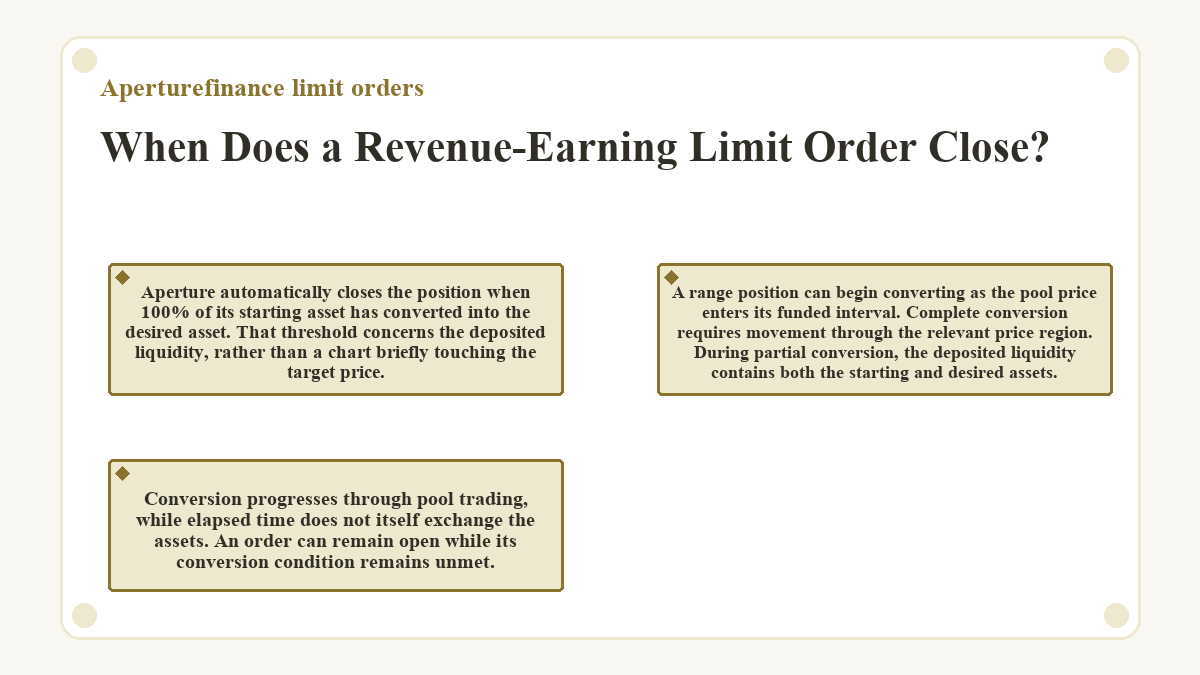
When Does a Revenue-Earning Limit Order Close?
Aperture automatically closes the position when 100% of its starting asset has converted into the desired asset. That threshold concerns the deposited liquidity, rather than a chart briefly touching the target price.
A range position can begin converting as the pool price enters its funded interval. Complete conversion requires movement through the relevant price region. During partial conversion, the deposited liquidity contains both the starting and desired assets. Conversion progresses through pool trading, while elapsed time does not itself exchange the assets. An order can remain open while its conversion condition remains unmet.
Price Reversals Before Withdrawal
An unwithdrawn range position can exchange back toward its starting asset if price crosses the funded region in the opposite direction. This makes manual closure sensitive to price movement after conversion. Aperture’s automatic closure addresses that monitoring task by acting on the completed conversion. A brief crossing followed by a reversal does not prove that the desired asset was withdrawn. The position’s actual holdings and closure outcome distinguish a completed exchange from liquidity that remains exposed to further pool trading.
Trading Fees and Gas Deductions
Trading fees contribute revenue to the conversion, while gas costs reduce the proceeds.
Earned Pool Fees
Fee revenue comes from trading against the position’s active liquidity. The pool’s fee setting influences what those trades generate. A trading-fee percentage describes a charge on swaps; it does not describe an annual return on the deposit or the order’s net profit.
Uniswap V3 fees accrue separately from the position’s liquidity. The protocol does not automatically add those fees back to the position as they accrue. Aperture’s fee-reinvestment tools address a separate task from completing a revenue-earning limit order.
Execution Costs
Gas costs reduce the proceeds of a completed revenue-earning limit order. Earned trading fees can offset some of that deduction, but their presence alone does not establish a positive net trading outcome.
Aperture has separate charging rules for swaps, reinvestment and rebalances. Those rules concern their respective operations, so combining them into an assumed limit-order charge would mix different services. The cost terms applicable to the selected order determine any additional deductions.
Range Boundaries and Execution Price
Uniswap V3 positions occupy bounded price intervals, so a target tick is part of a range-based exchange. Conversion takes place while trading crosses that interval. For a fully converted Uniswap V3 range order, the average conversion price before earned fees is the square root of the product of its two boundary prices. Usable tick spacing also relates to the pool’s fee tier. This affects the granularity of available position boundaries at the protocol level. At the Uniswap V3 level, a wider range may earn more fees from repeated in-range trading. It also increases the risk of incomplete conversion if the pool price reverses before crossing the full interval.
Uniswap V3 Pools and Order Availability
The revenue-earning limit-order mechanism uses Uniswap V3 liquidity. Aperture also has broader liquidity tooling for PancakeSwap V3 and ApertureSwap. Support for those venues does not establish identical order features across every pool and chain.
Some pools require initialization before adding liquidity. The chosen assets, pool and fee tier must refer to the same intended position. A recognizable token name does not identify its contract on a particular chain or distinguish between pools with different settings.
Order placement requires a configuration that supports this asset-conversion task. A pool’s existence supplies the venue for liquidity, while the application’s order mode supplies the automation. Both must match the intended order before the position is funded.
Conditional Closure and Recurring Rebalancing
Aperture’s automated position closure can use a price, token-ratio or time condition. Its revenue-earning limit order closes on full asset conversion. Recurring rebalancing repeatedly adjusts a liquidity position when its configured trigger is met. These tools pursue different outcomes: withdrawal under a chosen condition, completion of an asset exchange or repeated repositioning of liquidity.
How Can the Returned Assets Be Reconciled?
Reconcile the returned assets by separating converted liquidity, collected trading fees and gas deductions in their actual token units. The settlement concerns received assets, rather than the target price considered alone.
The starting amount and the destination amount use different asset units. A pool quote expresses their relative price; it is not itself a received balance. Likewise, a monetary gas estimate cannot be added directly to a token amount. Each deduction needs the unit and basis that applies to that charge.
Closure establishes that the position no longer holds the withdrawn liquidity. Returned balances establish what reached the account. Earned fees may contribute separate token amounts, so the destination balance alone need not explain every settlement component. Withdrawn capital no longer participates in that position’s subsequent pool trading.
Key questions about Aperturefinance limit orders
Can a TWAP Setting Change the Price That a Limit Order Uses?
Aperture’s limit-order pricing uses the current on-chain liquidity-pool price. TWAP, or time-weighted average price, appears in separate duration-based price and ratio trigger settings. Those settings do not establish a time-averaged pricing input for the revenue-earning limit-order mechanism.
Why Could the Starting Token Appear in Fees After Full Conversion?
Uniswap V3 range positions can accrue trading fees in both pool tokens. Full conversion measures deposited liquidity, so a starting-token amount identified as collected fees can coexist with a fully converted position.
Is a Sell stop-loss Available Through single-sided Range Liquidity?
Single-sided Uniswap V3 range liquidity cannot reproduce a conventional sell stop-loss below the current price. That placement requires the opposite pool asset as liquidity. Aperture’s conditional position-closure tool uses a separate trigger model; its price-based closure capability does not turn a revenue-earning range order into a sell stop-loss.
Does Rebalancing Through 1inch Execute the limit-order Fill?
The 1inch route belongs to Aperture’s rebalance swap flow. That flow uses 1inch as its default liquidity source and has a same-pool fallback if the swap encounters problems. A revenue-earning limit order exchanges assets through its funded Uniswap V3 liquidity position. The rebalance route does not describe that position’s conversion mechanism.
Where Does a Token Contract Address Fit Into limit-order Preparation?
Aperture may require importing a low-volume token by its contract address before selecting it for a liquidity position. The address identifies the asset on a particular chain. Importing the token does not initialize a pool or establish which order features that pool supports.
How Is a Recurring Gas Ceiling Different From a limit-order Charge?
A recurring gas ceiling limits allowed gas expenditure for recurring rebalances, while a limit order’s gas deduction represents an execution cost. The recurring setting measures its ceiling against the managed position’s value and permits a maximum of 20%. That percentage is an allowance for the strategy’s gas burden, not a flat charge for placing a limit order.