 Aperturefinance
 Liquidity Automation and Market Making
Aperturefinance combines concentrated-liquidity automation with on-chain market-making tools and an intent-based execution model. Its Liquidity Intents manage individual positions through rebalancing, scheduled closure and fee reinvestment. Market Making as a Service, or MaaS, adds inventory management and maker or taker rebalancing for protocol owners. The broader intent architecture connects user-defined outcomes with solver execution, including a gasless payment model. These functions address different liquidity tasks, with their own settings, costs and compatibility limits.
Updated on
Position Automation and Protocol Market Making
Liquidity Intents act on a selected liquidity position, while MaaS manages the inventory and active liquidity of a protocol. A position-level tool changes that position’s range, withdraws its liquidity or reinvests its earned fees. MaaS coordinates liquidity provision with the protocol owner’s inventory and market-making preferences.
A liquidity-position rebalance adjusts the assets and range of that position. MaaS also offers maker and taker approaches to managing token inventory. Those terms describe how the necessary assets are acquired or converted, a separate dimension from whether an action runs once or repeatedly.
Concentrated Liquidity Across Supported Venues
Concentrated liquidity places assets inside a chosen trading-price range, which makes range selection central to Aperturefinance’s liquidity tools. Uniswap V3 support includes Ethereum, Arbitrum, Optimism, Polygon, Base, BNB Chain, Avalanche C-Chain and Scroll. PancakeSwap V3 support covers Ethereum and BNB Chain. The compatibility list also includes SlipStream on Base and ApertureSwap on Manta Pacific.
These integrations combine a specific automated market maker, or AMM, with a network. Recurring rebalancing is not supported on Manta Pacific. A concentrated position’s token mix changes as trading moves the pool price through its range. Price movements can create impermanent loss relative to holding the deposited assets. Fee income and asset-price changes both affect the position’s value.
Natural-Language Intent Design and Solver Quotes
Aperture’s AI intent architecture centers on translating natural-language requests into a readable domain-specific language, or DSL. Within that design, a chatbot identifies the requested assets, permitted actions and desired end state. The structured expression defines the terms for a solver’s proposed solution. Product and interface support determine which actions a request can authorize. The broader design includes verification of proposed solutions and ranking by outcomes and solver scores.
The solver network obtains quotes from multiple participants, including Propeller Heads and Enso. Quotes offer different proposed ways to execute an intent. Market liquidity and the request’s constraints determine whether a proposed solution is suitable. A quote states an execution proposal; it does not establish that the requested operation has finished.
Single Rebalances and Recurring Strategies
A one-time rebalance changes a liquidity position when its selected price, token-ratio or time condition permits the action. Recurring strategies repeat their rebalance rule as the relevant pool-price or token-ratio condition recurs.
One-Time Range Adjustments
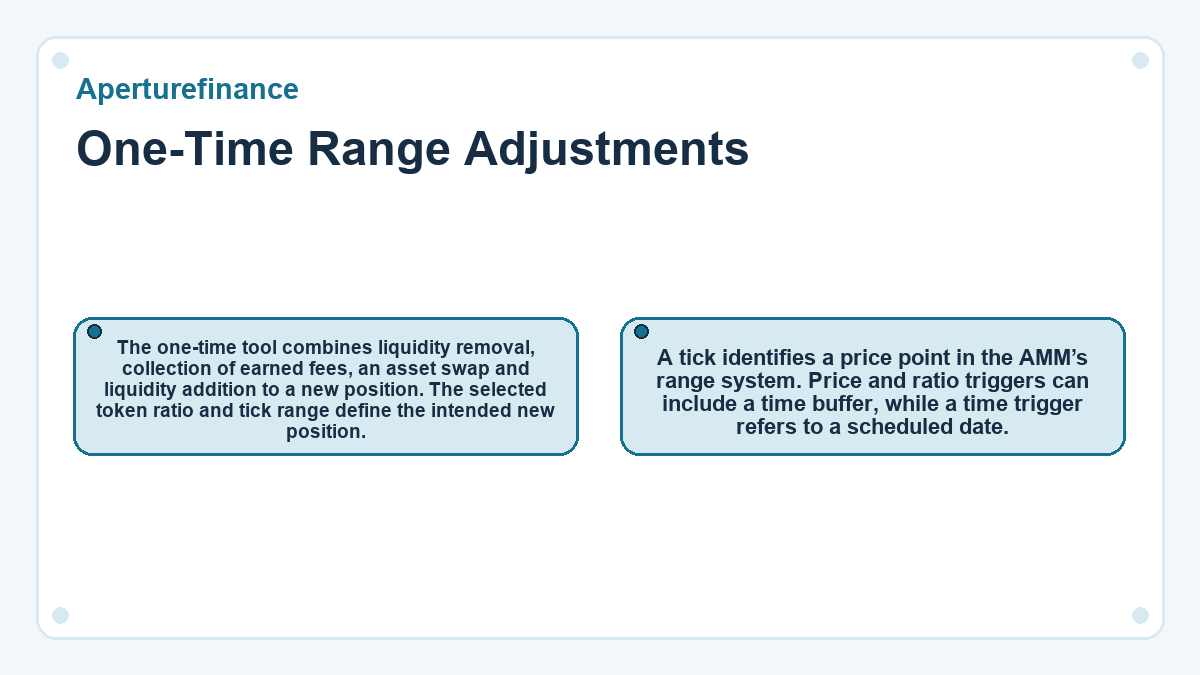
The one-time tool combines liquidity removal, collection of earned fees, an asset swap and liquidity addition to a new position. The selected token ratio and tick range define the intended new position. A tick identifies a price point in the AMM’s range system. Price and ratio triggers can include a time buffer, while a time trigger refers to a scheduled date.
Recurring Pool Rules
A recurring strategy responds to movements in the pool price or changes in the position’s token ratio. Its settings can express a range around the future pool price or specify a target asset ratio and tick width. An optional time-weighted average price, or TWAP, smooths the price input.
Position Closure and Revenue-Earning Limit Orders
Scheduled closure withdraws a selected position’s liquidity, while a revenue-earning limit order uses a single-asset position to target conversion into another asset.
Conditional Position Closure
A closure trigger can use pool pricing, the token ratio or a scheduled time. Price and ratio conditions may also include a time buffer. Closure removes liquidity and returns the resulting assets to the wallet. The composition of those assets follows the position’s state when it closes. A gas-fee ceiling remains part of the scheduled-close settings.
Single-Sided Limit Orders
Revenue-earning limit orders use single-sided Uniswap V3 liquidity outside the current trading range. As the pool price passes through the selected price level, trading converts the starting asset into the desired asset. Aperture automatically closes the position after that conversion completes. Trading fees contribute to the proceeds, and gas costs reduce them.
Reinvestment of Earned Fees
Auto-compounding reinvests accrued trading fees into the same liquidity position when the fee and gas conditions permit it. Aperture compares earned fees with execution costs and incorporates the swap needed to fit the position’s token ratio. Minimum-fee and maximum-gas settings govern the operation. Those inputs can use dollar amounts or percentages of position value.
Reinvested fees become part of the position’s exposure to subsequent price movements.
What Does a Gasless Intent Cost?
Gasless intent execution carries fees even when the user does not make a separate network-gas payment. Aperture Solvers pay network gas for the gasless intent flow. Fees are deducted in tokens chosen by the user.
Liquidity intents include a network-specific gas surcharge to account for possible failed transactions. Slippage and other execution problems can leave the solver paying gas for an unsuccessful attempt. Separate service fees apply to swapping, rebalancing and compounding.
The fee schedule lists swap service fees of 0.25%. Rebalance service fees combine 0.15% of position value with $0.15 per rebalance. The schedule also lists an approximate 3% service fee for compounding.
Gas ceilings constrain whether a scheduled operation can execute at the prevailing network cost. The one-time setup converts a dollar-denominated ceiling into a percentage of position value, which is the basis that the trigger uses.
Maker and Taker Management Under MaaS
MaaS combines protocol inventory with active concentrated liquidity, using maker and taker rebalancing for different market-management needs.
Vault Inventory and Active Liquidity
Protocol owners deposit project tokens with ether or a stablecoin into Aperture-managed vaults. The vault divides assets between inventory and active liquidity. Only the protocol owner can withdraw the assets; Aperture manages liquidity and inventory under the protocol’s instructions. Active liquidity rebalances gradually around the current pool price according to the protocol’s liquidity preference.
Maker Rebalancing
Maker rebalancing acquires the required token balance through passive conversion while providing liquidity in an AMM. Conversion follows pool trading, so this method has a different timing profile from acquiring tokens through existing liquidity. The position remains exposed to changing market conditions during that process.
Taker Rebalancing
Taker rebalancing obtains assets through existing on-chain liquidity when faster adjustment matters. The MaaS design associates that choice with accepting the realization of impermanent loss. Its inventory toolset also includes TWAP and volume-weighted average price, or VWAP, methods for acquiring or liquidating assets through maker or taker execution.
Authorization and Execution Conditions
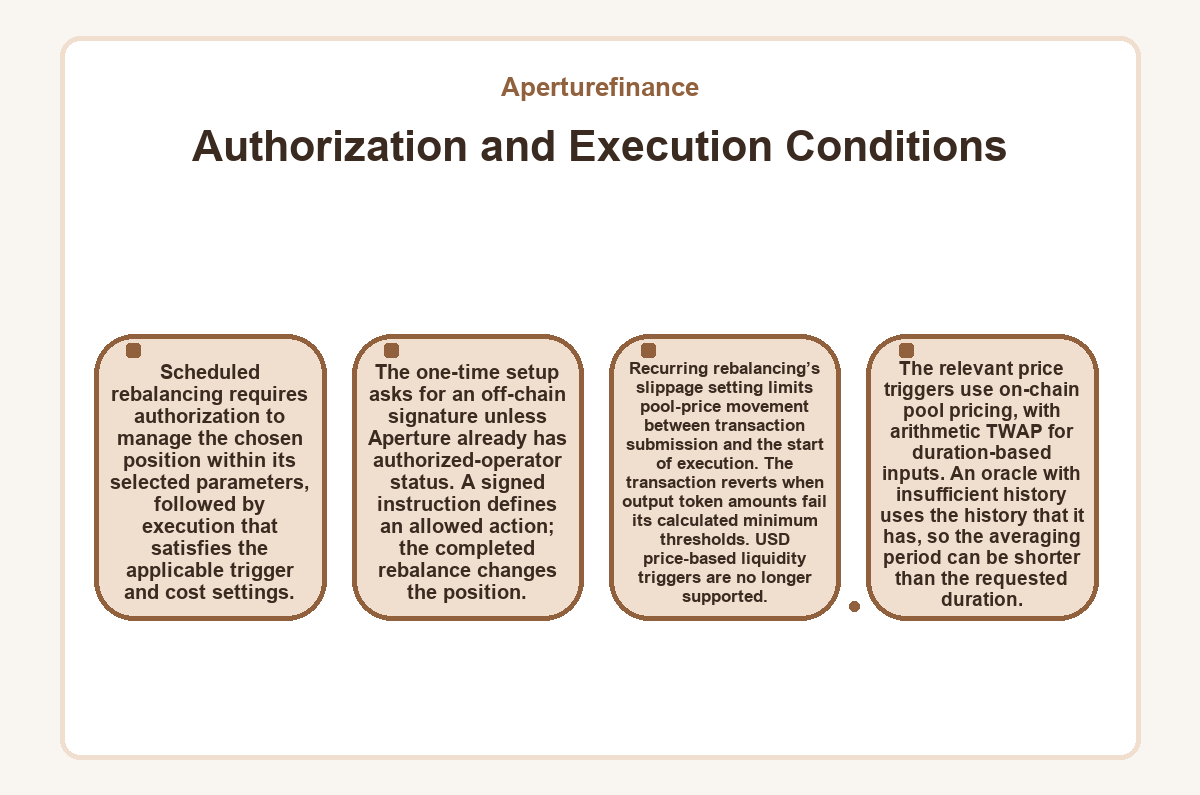
Scheduled rebalancing requires authorization to manage the chosen position within its selected parameters, followed by execution that satisfies the applicable trigger and cost settings. The one-time setup asks for an off-chain signature unless Aperture already has authorized-operator status. A signed instruction defines an allowed action; the completed rebalance changes the position.
Recurring rebalancing’s slippage setting limits pool-price movement between transaction submission and the start of execution. The transaction reverts when output token amounts fail its calculated minimum thresholds.
USD price-based liquidity triggers are no longer supported. The relevant price triggers use on-chain pool pricing, with arithmetic TWAP for duration-based inputs. An oracle with insufficient history uses the history that it has, so the averaging period can be shorter than the requested duration.
Application Access and MaaS Service Controls
Aperture pairs web application access with documentation for its application programming interface, or API. The recurring-strategy setup accepts a newly opened position or an existing supported position.
MaaS allows more involved management or largely automated operation, with configurable control over liquidity strategies. It also includes market-analysis and response tools. Customer-support service-level agreements, or SLAs, define the enterprise support relationship.
Matching the Tool to the Liquidity Task
The choice begins with the desired change to the assets: range adjustment, withdrawal, conversion, fee reinvestment or protocol-level inventory management.
- Check that the position’s AMM and network support the chosen automation.
- Use a one-time rebalance for one range change, or a recurring strategy for repeated pool-price or ratio conditions.
- Choose scheduled closure for liquidity withdrawal, or a revenue-earning limit order for complete single-asset conversion.
- Assess auto-compounding through its minimum-fee setting, gas ceiling and reinvestment cost.
- For protocol inventory and active liquidity management, choose the toolset with maker and taker controls: MaaS.
Aperturefinance questions worth asking
-
What Does Aperture’s $100,000 Outreach Threshold Refer To?
- The $100,000 threshold refers to a dedicated outreach option for asset managers and individuals planning to invest more than that amount. It identifies a contact category for additional resources and arrangements. That outreach threshold should not be treated as a minimum deposit rule for every liquidity tool.
-
Why Can a TWAP-based Trigger Remain Inactive After Its Selected Duration?
- A trigger using a time-weighted average price (TWAP) waits at least its specified duration, and editing it resets that waiting period. Restrictive slippage or gas-fee ceiling settings can also prevent execution after that interval.
-
Where Do Unclaimed Trading Fees Go When a Position Is Rebalanced?
- Unclaimed trading fees move into the new liquidity position during a rebalance. A separate auto-compounding setting governs fee reinvestment between rebalances, so transferring the fee balance during a rebalance and scheduling later compounding are different operations.
-
Does a Missing Token in the Picker Mean Its Pool Is Unsupported?
- A token’s absence from the picker does not by itself establish that its pool is unsupported. Some tokens with low trading volume may require importing by address. A pool may also need initialization before liquidity can be added, which is a separate condition from finding the token.
-
When Do one-time Rebalance Triggers Expire?
- One-time rebalance triggers expire automatically after 90 days in that setup. The scheduled trigger must remain active when its condition is met for the associated rebalance to execute.
-
Is MaaS Restricted to Protocols That Have Already Launched a Token?
- MaaS is designed for protocol owners before a token launch and established projects after launch, with customizable liquidity strategies and inventory tools that address different development stages.
-
Are Aperture’s Liquidity Automation Contracts Open for Inspection?
- Aperture publishes the UniV3Automan contract in the uniswap-v3-automan repository. It supports rebalancing, reinvesting and token swaps. The contract uses OptimalSwap to calculate a token-swap amount from the desired asset ratio and its effect on the liquidity position. Separate uni-v3-lib code includes modified SqrtPriceMath and TickMath libraries for integrators.